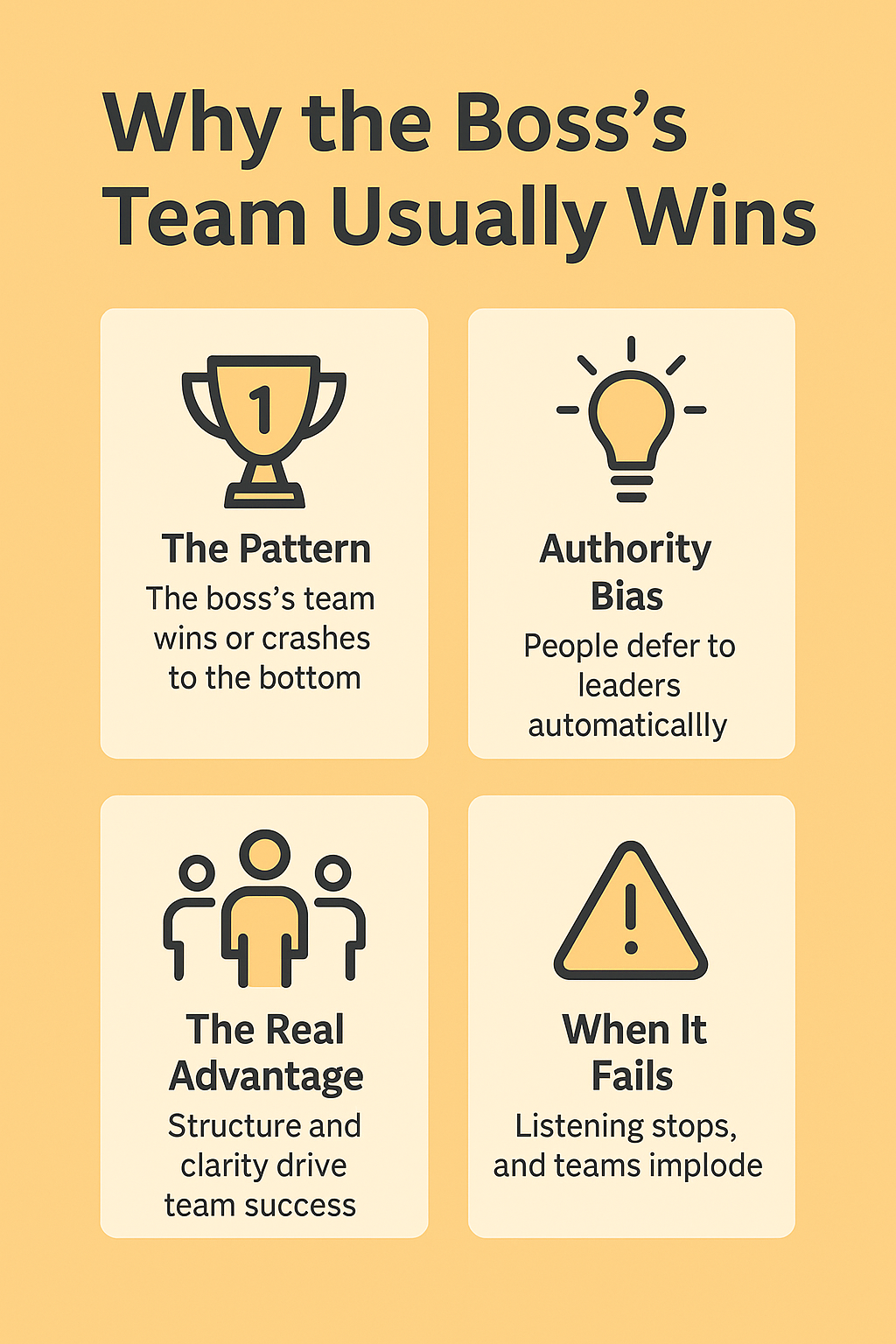
After almost a decade of facilitating team-building events, one pattern has become oddly predictable: the team with the boss almost always wins until they don’t. When they lose, they don’t just miss by a little. They either take second place or crash to the bottom.
So what’s the deal? How do leadership dynamics play such a visible role in a team’s success or failure? I’ve seen this pattern repeat across hundreds of programs, and it says a lot about how people organize themselves under pressure.
Before diving deeper, let me briefly explain a few of the types of team events I’m talking about. We run fast-paced Amazing Races through downtown areas, Team Survivor events packed with competitive mini-games, and Escape the Case, a table-based, lightly competitive challenge focused on organizing fractured information, among others.
Across all these formats, the “Boss Rule” holds true. Teams are randomly formed, so the boss might end up with other managers or, more often, with employees they’ve never met. Yet the same dynamic emerges almost every time.
Authority Bias and Beyond
The obvious answer is Authority Bias. Of course, people defer to the boss. They follow their lead, stay quiet, and try not to overstep. Simple, right? Maybe. I think there’s more to it.
When people automatically rally behind a leader, what they’re really doing is placing faith in a decision-maker. It’s not about fear. It’s about clarity. The team knows who filters ideas, makes calls, and keeps things moving. In other words, the structure itself, not the title, creates momentum. Often there are multiple solutions to a problem, and ironically, choosing one becomes the real challenge.
It’s not about hierarchy, consciously or subconsciously. It’s about the group functioning with purpose. It could be anyone on the team. You could rotate who plays the “boss” and likely get the same outcome. The real key isn’t the title; it’s the behavior. When a team listens to one another, delegates tasks, and keeps moving forward with shared purpose, they perform better. Success comes from active participation, sharing ideas, and trust in the process, not from who happens to be holding the top spot.
The boss’s team usually wins not through authority, but because they gain a head start by functioning more effectively while other teams are still finding their rhythm.
When They Crash
Of course, there’s a flip side. When that central figure stops listening, when confidence turns into stubbornness, the system fails fast. If the person holding the wheel ignores the crew spotting the rocks, the ship runs aground. It doesn’t matter if it’s an office project or our Escape the Case challenge. One person can’t see everything. Maybe they just forgot their cup of coffee that morning.
In my experience, an ineffective leader does more harm and finishes lower than a group struggling to make decisions without a clear team structure. In this case, the boss does more harm than good and becomes the bottleneck to the team’s success.
Teams collapse when information stops flowing. A leader who doesn’t welcome ideas, check for clarity, or delegate creates blind spots. Without shared trust, understanding, and input, confusion replaces coordination. That’s why the boss’s team doesn’t just lose, they implode.